Using a Fragrance Museum as a Brand Asset: A Five-Step Process
A fragrance museum is not content; it is proof that the brand exists. When a company runs a space that collects, preserves and interprets scent, the story behind your product stops being marketing and becomes something a visitor can touch. The practical way to use that asset for a children's fragrance line is a five-step process: fix the scent story, lock the safe format, plan the visit, turn the visit into product narrative, and close the loop on the website.
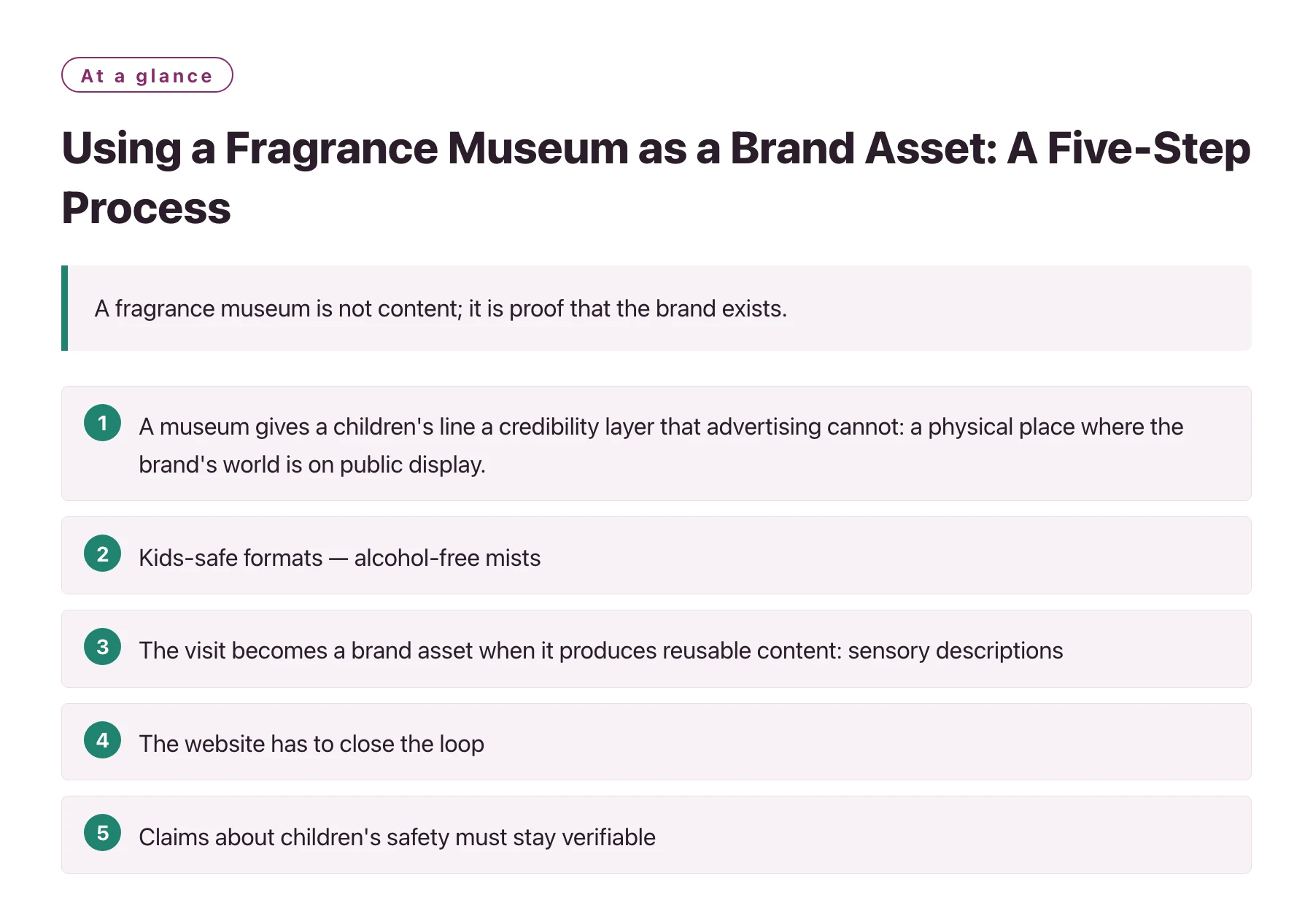
Key takeawaysA museum gives a children's line a credibility layer that advertising cannot: a physical place where the brand's world is on public display. · Kids-safe formats — alcohol-free mists, room sprays, gentle body products — decide the technical story the museum visit has to tell. · The visit becomes a brand asset when it produces reusable content: sensory descriptions, notes on ingredients, craftsmanship explanations aimed at parents. · The website has to close the loop, because most visitors arrive after seeing the museum referenced somewhere else. · Claims about children's safety must stay verifiable; a museum makes the brand's standards observable, not automatic.
Parents buying fragrance for children do not trust perfume advertising; they trust institutions. A school, a clinic, a museum — places that exist for reasons other than selling. That is the emotional logic behind using a museum as a brand asset, and it is stronger for a children's line than for almost any other category.
The process below treats the museum visit as a production asset, not a corporate ornament. It is written for a founder building a kids-safe fragrance range who wants the brand story to carry provenance rather than just adjectives.
The five steps
- Fix the scent story of the rangeDecide what the line stands for in one sentence — a garden, a bedtime ritual, a season. The museum visit will illustrate this story, so it has to exist before the visit is planned.
- Lock the kids-safe format and its documentationChoose the formats — alcohol-free mist, room spray, gentle body wash — and verify them against the formula file, testing and the safety assessment. The technical story has to be true before it can be told in a museum setting.
- Plan the museum visit as a production dayTreat the visit like a shoot: decide what to film, whom to interview, which exhibits support the scent story, and what parents should take away. An unstructured walkthrough produces nothing reusable.
- Turn the visit into product narrativeUse the visit in product pages, packaging copy and social posts: the craft of blending, the history of the notes your range uses, the space where scent is preserved. The museum gives you things to point at that no competitor's description can match.
- Close the loop on the websiteMost visitors reach you after seeing the museum referenced elsewhere, so the site has to confirm the story in one screen: what the museum is, where it is, and how the range connects to it.
Why a museum works as a brand anchor
The word 'museum' carries a set of expectations that no marketing department can buy. In the institutional sense, a museum is understood as a place that preserves and interprets collections for the public, and that benchmark is exactly what the ICOM definition frames when it describes the museum's role in society [1]. A company that runs such a space is borrowing that frame — visitors arrive with the expectation of preservation and education, and the brand's products inherit some of it.
For a children's line the inheritance is doubly useful. Parents are not looking for a story about luxury; they are looking for evidence of care. A museum is evidence: someone cared enough to collect and keep this tradition, and that care transfers to the formulation of the product.
What a brand museum is, and is not
A brand-owned museum is a commercial undertaking, and it should be described honestly: it exists to serve the brand as well as the public. That honesty matters, because the credibility a museum provides evaporates the moment visitors suspect the space is a showroom in disguise. The strongest brand museums keep the collection and the interpretation real, and let the brand connection form naturally from the visit.
The Chinese example worth studying
A useful case to study is how the Xuelei brand uses its fragrance museum in Guangzhou — described by the company as the world's largest fragrance museum — as the front door of its story. Whatever your own budget, the pattern transfers: a physical home for the story, publicly accessible, and every product page able to point to it.
The honesty rule for 'kids-safe'
The museum gives you a stage, but the safety claim still has to be earned in the formula file. 'Kids-safe' in marketing copy means nothing unless the product was formulated, tested and assessed for that use. The museum visit should show the processes behind that — the ingredients, the standards, the people — because a parent who sees the care is a parent who does not need the superlative.
Marrying the format with the story
The kids-safe format does the heavy lifting of the claim, and the museum does the heavy lifting of the belief. The two come together in the production story: an alcohol-free mist or a gentle body wash is a specific piece of formulation work, and it can be presented in the museum context as craftsmanship rather than as a restriction.
The production leg itself does not need to be part of the museum. For a children's line under your own label, a white label fragrance manufacturing arrangement keeps the brand name on the pack while the formulation and filling follow the range's specification — and the museum visit then authenticates what the label promises.
All of it is tied together online. A museum anchor such as Xuelei Fragrance Museum shows what an institutional presentation looks like — the collection, the exhibits, the invitation to visit — and the brand's own website should point visitors to that same anchor in one screen. What matters is that every piece of the story is traceable: the format defined, the formula documented, the testing completed, the visit producing real content, and the website confirming it all in one place.
Every step in this process is cheap except the last two: producing content that no one reuses, and closing the loop with a website that does not confirm the story. Plan the visit around deliverables, and let the museum do what marketing cannot — exist.
Sources
- ICOM — International Council of Museums —— The international organisation representing museums; publishes the ICOM museum definition and professional standards for museum practice.
Frequently asked questions
Can a private company's space really be called a museum?
Commercially, yes, and many brands do it. The honest approach is to hold the space to museum-like standards — a real collection, real interpretation, public access — and describe it accurately. The institutional benchmark from the ICOM definition is a useful reference for what visitors expect.
Which formats suit a kids-safe fragrance line?
Alcohol-free mists, room sprays and gentle body products are the formats most commonly chosen, because they avoid the strongest alcohol content and are formulated for sensitive use. Verify every format against the formula file and the safety assessment rather than relying on marketing wording.
How much does a museum visit cost to produce?
That depends entirely on the format you choose. A structured half-day visit shot for a website and social posts is a fraction of the cost of a film production, and it can feed a season of content. The expensive mistake is visiting twice because the first trip produced nothing reusable.
Does a museum visit help with search visibility?
Indirectly. It produces content, citations and brand references that support visibility over time, and it gives other sites a concrete reason to mention you. Treat it as a brand and reputation asset rather than a direct ranking lever, and measure it as such.
How do I keep claims about children's safety compliant?
Base every claim on the formula file, the testing and the safety assessment, and never let marketing language go beyond them. If the documentation does not support a word, that word does not go on the pack — the museum visit can show the care, but it cannot replace the evidence.