A Rooftop Rig at 26 TH/s: Testing the Smallest Tier Against Real Cooling
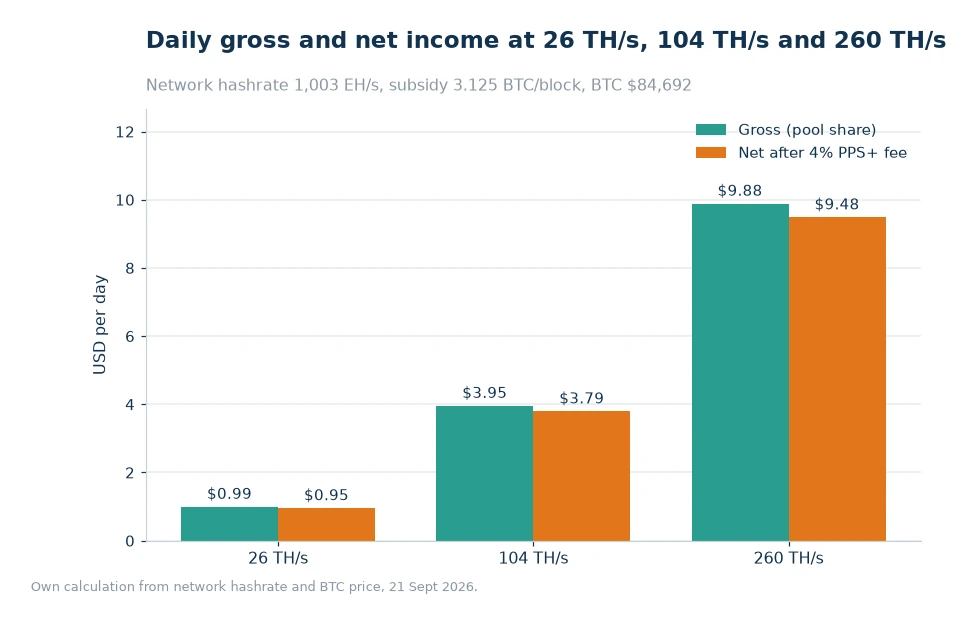
A 26 TH/s machine is the cheapest way into mining and the easiest way to lose money slowly. It returns roughly 0.00001167 BTC a day, about $0.99 at $84,692 per BTC and $0.95 once the PPS+ charge is taken. The figure that decides whether it belongs on a roof is not the dollar output but the kilowatt-hours it needs to produce it.

Key takeaways
- 26 TH/s yields 0.00001167 BTC a day, $0.99 gross and $0.95 net at the listed 4%.
- At 28 J/TH the rig draws 728 W, or 17.5 kWh a day, which sets a break-even tariff near $0.054 per kWh.
- 104 TH/s and 260 TH/s share almost the same break-even tariff, so size does not rescue a bad power price.
- Recovered heat is worth more than the coins at this scale if the building already burns fuel for warmth.
What the smallest tier is actually for
Nobody builds a business on 26 TH/s. It is a learning machine, a spare-capacity machine, or a way to turn otherwise wasted electricity into an asset. Judged as a business, it fails on almost any tariff above five cents. Judged as a way to understand the mechanics of a pool account before committing real capital, it is cheap tuition.
The trap is buying it as an investment and judging it by the daily dollar figure. At $0.95 net the numbers look harmless, because the losses are also small. A rig that loses $20 a month is easy to ignore for a year, and a year of ignoring it is $240 plus the hardware. That is the honest shape of the smallest tier: modest output, modest bleed, and a slow lesson.
The break-even tariff is the real specification
Every mining calculator asks for a power cost. Most operators type in the tariff on their bill and stop there. The more useful question runs the other way: at what tariff does this machine stop covering its own electricity? Solve for that number once and it becomes a filter you can apply to any machine in seconds.
| Hashrate | Draw at 28 J/TH | kWh per day | Net USD per day | Break-even tariff |
|---|---|---|---|---|
| 26 TH/s | 728 W | 17.47 | $0.95 | $0.0544/kWh |
| 104 TH/s | 2.91 kW | 69.89 | $3.79 | $0.0542/kWh |
| 260 TH/s | 7.28 kW | 174.72 | $9.48 | $0.0543/kWh |
The three tariffs are nearly identical, and that is the whole point of the table. Efficiency in joules per terahash, not hashrate, sets how much room a machine has above its power bill. Ten times the machines do not buy a tenth of a cent more headroom. Only a better joule ratio or a cheaper tariff can do that.
Heat is a second bill, or a credit
A 728 W rig in a closed room is a 728 W heater with a network cable attached. In winter that is not entirely waste: the kilowatt-hours displace something the building would have paid for anyway. The credit is easy to estimate. If heating fuel costs the equivalent of $0.08 per kWh of delivered heat, then 17.5 kWh a day of recovered heat is worth about $1.40, which is more than the $0.95 the pool pays.
Summer reverses the sign. The same rig has to be cooled, and cooling costs another fraction of a kilowatt-hour for every one the machine consumes. A rooftop unit with a fan and ducting can easily add 10% to 20% to the electrical load in July. An operator who counted on winter figures will find the summer months unprofitable even before the difficulty moves.
The practical conclusion for a rooftop install is to plan the air path before the machine arrives. Pulling outside air through a filtered inlet and dumping it under a vented ridge is crude but effective. Recirculating air in a sealed box is how a 26 TH/s rig ends up throttling in its first heatwave.
Why 104 TH/s is the awkward middle
Four times the hashrate brings four times the coins and four times the heat, and it does not change the wiring problem much. A 104 TH/s unit at 28 J/TH draws just under 3 kW, which is a dedicated 240 V circuit in most buildings. That is a real electrician's visit, a real breaker, and a real conversation with whoever owns the property.
The middle tier is also where monitoring starts to matter. One machine can be checked by ear. Four machines, or one machine with four times the output, deserve an alert that fires when the hashrate drops. The pool account shows the truth within a few minutes of a board failing, and the network statistics page tells you whether a dip is yours or everyone's.
Running the scenario before the purchase
Take the smallest tier and test it three ways. At $0.04 per kWh it clears $0.25 a day. At $0.08 it loses $0.45. At $0.12 it loses $1.15. The swing between the first and last case is $1.40 a day, which is larger than the pool credit itself in every scenario. Power price dominates output at this scale, and any comparison that holds the tariff fixed while varying the hashrate is measuring the wrong variable.
This is where a tool beats a spreadsheet. The ViaBTC Mining Calculator lets you change the tariff, the difficulty estimate and the settlement rate in one place, so the three scenarios above take a minute rather than an evening. Feed it the same figures you would write on the purchase page and check that the answer survives a 20% move in coin price.
Do the same for 260 TH/s. If the larger machine only works at a tariff you cannot get, the smaller one is not a stepping stone; it is the same bad economics with fewer zeros. The Profit Calculator keeps the three scenarios in one place, so the comparison stays like for like.
When 260 TH/s makes the roof work
The top tier earns $9.88 gross and $9.48 net a day, which is roughly ten times the smallest tier for roughly ten times the electricity. It becomes interesting for a different reason: the fixed costs of a rooftop installation, the ducting, the electrician, the monitoring, are spread over ten times more output. At 26 TH/s those fixed costs can exceed the annual coin output. At 260 TH/s they shrink to a rounding error.
That is the only genuine argument for going bigger on a roof. Not better margins, but better amortisation of things that do not scale with hashrate. If the ducting quote is the same for one machine and ten, the larger install is the one that makes the ducting look cheap.
Worked example
Start from the network and stop at the electricity bill. The network share for 26 TH/s is 26 ÷ 1,003,000,000 = 0.0000000259. Multiply by 450 BTC a day and the result is 0.00001167 BTC. At $84,692 that is $0.99. Deduct the 4% PPS+ charge on the block reward and the net is $0.95.
Now the other side. At 28 J/TH the draw is 26 × 28 = 728 W. Over 24 hours that is 728 × 24 = 17,472 Wh, or 17.47 kWh. Divide the net credit by the energy: 0.95 ÷ 17.47 = $0.0544 per kWh. That is the tariff at which the machine breaks even, before cooling, before the fan that moves the air, and before any share of the roof.
Scale the same arithmetic to 260 TH/s: 260 × 0.0000004486 = 0.00011664 BTC, or $9.88 gross and $9.48 net; 260 × 28 = 7,280 W; 7.28 kW × 24 = 174.72 kWh; 9.48 ÷ 174.72 = $0.0543 per kWh. The break-even barely moves, which confirms that the joule ratio, not the tier, is doing the work.
Frequently asked questions
Can a 26 TH/s rig pay for itself?
It can cover its electricity at a tariff below about $0.054 per kWh, but at $0.95 net a day the hardware is a long repayment. Treat it as a learning cost unless power is effectively free to you.
Does a bigger miner get a better rate per terahash?
No. The pool credits the same amount per terahash at every size, so gross margin per unit of hashrate is flat. Bigger machines win only when they spread fixed installation costs over more output.
How much heat does a small rig add to a room?
Nearly all of the electricity becomes heat, so a 728 W rig adds about 728 W of heating while it runs. In summer that load has to be removed, which is why rooftop installs need an air path planned in advance.
Measure the roof before you measure the coin
Walk outside with a thermometer and a tape measure before ordering anything. Find the inlet, find the exhaust, and work out where the hot air goes in July. Then check the tariff against the break-even column above. If the roof can move the air and the tariff sits below five cents, the smallest tier is a reasonable place to start.
If either answer is no, the machine will still run. It just will not be earning. Keep the payout address in a multi-currency wallet you control, and revisit the decision after a full season rather than after a good week.
Sources: ViaBTC pricing and calculator pages for the PPS+ rates[1]. Market values from 21 Sept 2026 were $84,692 for BTC, 1,003 EH/s of network hashrate, 132.76 T of difficulty and a 3.125 BTC subsidy across 144 daily blocks. Published 24 Oct 2026. The 28 J/TH figure and the tariffs are assumptions.